Expected Value in Plain English: The Maths Behind Every Bet
Expected value tells you what a bet is worth on average. A worked example shows why a positive-value bet can still lose for months.
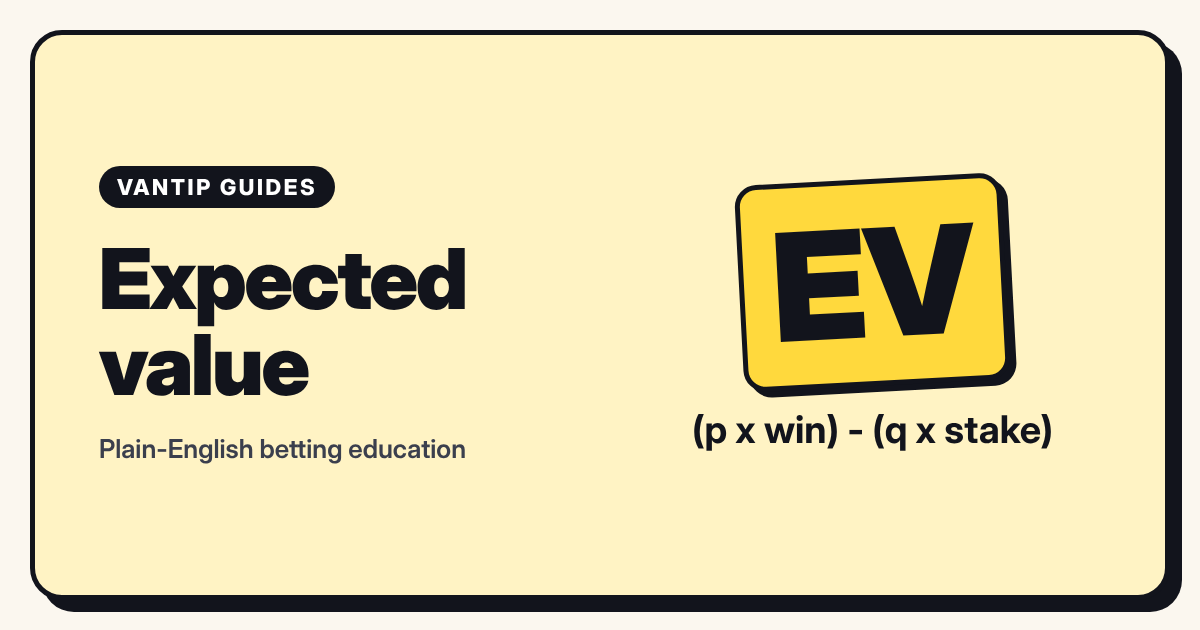
Expected value, usually shortened to EV, is the average result of a bet if you could place it over and over. It is the single best way to describe whether a price is good or bad, and it explains why short-term results tell you very little.
The formula
For a bet at decimal odds, the expected value per 1 staked is:
EV = (probability of winning x odds) - 1
A positive number means the bet makes money on average. A negative number means it loses on average. Zero means it is exactly fair.
A worked example with value
You are offered odds of 2.20 on an outcome. You estimate it wins 48% of the time.
- EV = (0.48 x 2.20) - 1 = 1.056 - 1 = +0.056
That is +5.6% of your stake per bet, on average. The odds imply 1 / 2.20 = 45.5%, so your estimate sits 2.5 points above the price. That gap is the edge, and it is what turns into positive EV.
A worked example without value
A match is priced at 2.10 for the home side. After removing the margin (see implied probability and the margin), the market's own view is that the home side wins 45.4% of the time.
- EV = (0.454 x 2.10) - 1 = 0.953 - 1 = -0.047
If the market is right, you lose about 4.7% of each stake on average. This is the cost of the bookmaker's margin, and it is why betting on prices at random loses money.
The break-even probability
Rearranging the formula, a bet breaks even when your win probability equals 1 divided by the odds. At 2.20 that is 45.5%. At 1.91 (the usual American -110 price) it is 52.4%. Every price has a bar like this. Your estimate has to clear it, by enough to cover the error in your estimate.
Positive EV does not mean winning
Here is what makes EV hard to live with. Take the 2.20 bet above, with a 48% chance of winning:
- Win: you gain 1.20 (probability 0.48)
- Lose: you lose 1.00 (probability 0.52)
The expected profit per bet is +0.056, but the typical swing on any single bet is about 1.1. Over 100 bets, the expected profit is about +5.6 units, and the standard deviation is about 11 units. That means:
- After 100 bets, you would still be losing roughly 3 times in 10 (about 30%), even with a genuine edge.
- After 1,000 bets, the expected profit is about +56 units with a standard deviation of about 35, and the chance of being behind falls to about 5%.
So a real +5.6% edge needs hundreds of bets before it reliably shows up. A smaller edge needs thousands. This is covered in more depth in variance and sample size.
Two warnings
EV is only as good as your probability. The formula is simple. The probability is the hard part, because you never know it, you only estimate it. A bettor whose estimates are 3 points too high believes every bet is +EV and loses steadily. See value betting explained.
EV is not a staking plan. Knowing a bet is +EV does not tell you how much to stake. Staking too much on an uncertain edge can ruin a bankroll before the edge appears. See bankroll basics.
How EV connects to Vantip
On each tip you can see the model's confidence, the bookmaker's implied probability and the edge between them. That edge is an estimate of expected value, not a promise. Because our AI starts from the market's own probability, the edges are small, and we have not yet shown that our model beats the bookmaker. The Track Record page logs every result, and our methodology explains each number.
Takeaways
- EV = (probability x odds) - 1.
- Compare your probability with 1 divided by the odds.
- A positive-EV bet still loses often, and a run of results proves little.
- Estimates carry error, so assume your edge is smaller than you think.
Vantip Team. Information only, not betting advice. 18+. Betting carries risk; see our Responsible Gambling page.
Written by the Vantip Editorial Team. See how we analyse matches and build our predictions.
For informational purposes only. Betting involves financial risk — never stake more than you can afford to lose. 18+ · Gamble responsibly.