Value Betting Explained: Why a Likely Winner Is Not Always a Good Bet
Value betting is about price, not prediction. See why a likely winner can be a bad bet, and how a longshot can be a good one.
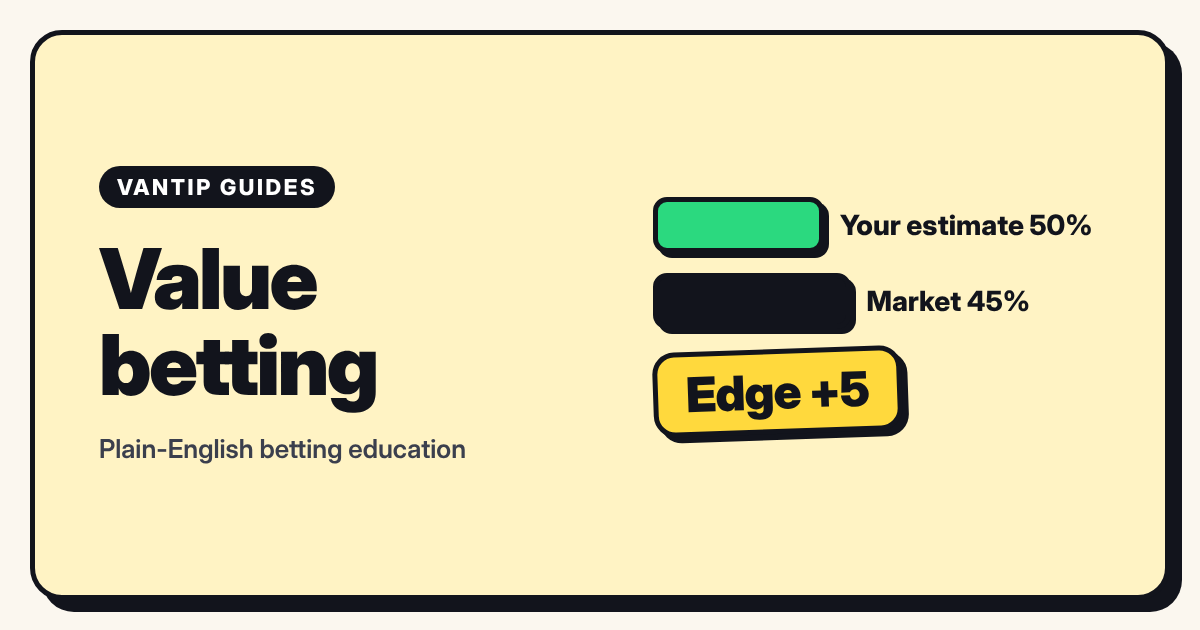
Most people ask who will win. Value bettors ask something different: is the price right? These are separate questions, and mixing them up is one of the most common and costly mistakes in betting.
The core idea
A bookmaker's odds imply a probability. A bet has value when your honest estimate of the true probability is higher than the probability the odds imply. It has no value when the odds already price in everything you know.
Value is about the gap between price and probability. It says nothing about whether the bet is likely to win.
Two examples
A favourite with no value. A team is priced at 1.30, which implies 76.9%. You think they win 75% of the time. They are very likely to win, yet the bet loses money over time, because you are paid as if they win 76.9% of the time and they do not.
A longshot with value. A team is priced at 6.00, which implies 16.7%. You think they win 20% of the time. They will lose four times out of five, yet the bet makes money over time: 20% of the time you collect 6.00 for each 1 staked, so each 1 staked returns 1.20 on average.
Why most bets have no value
Bookmaker prices come from large amounts of data, from models, and from bettors correcting them. By kick-off the price is usually very close to the true probability, and the margin takes a share on top. Genuine edges are rare and small. Anyone offering you a stream of big, certain edges is selling something.
The hard part: your probability is an estimate
You never know the true probability. You estimate it, and estimates carry error. If you are 3 points too optimistic on average, every bet you think has value is actually fair or worse. This is why serious bettors:
- Start from the market's no-margin probability and adjust only for specific, nameable reasons. See implied probability and the margin.
- Track results over hundreds of bets before trusting their own judgement. See variance and sample size.
- Compare the price they took with the final price. See closing line value.
How this shows up on Vantip
Each tip shows the model's confidence, the bookmaker's implied probability and the gap between them (the edge), plus a value rating from 1 to 5 dots. Because our AI starts from the market's own probability and only moves it for a named reason, most edges are small, and some are zero or negative. We have not yet shown that our model beats the bookmaker, and every result is public on the Track Record page so you can judge for yourself. The full explanation is in our methodology.
Takeaways
- A likely winner and a good bet are different things.
- Compare your probability with the no-margin market probability.
- Expect small edges, long losing runs and slow results.
- No honest source can promise a profit.
How to form a probability estimate
Since value depends on your probability, how you form it matters. A sound method looks like this:
- Start from the market. Take the no-margin probability from the odds. It is the best neutral starting point, because it already reflects a lot of information. See implied probability and the margin.
- Adjust only for specific, nameable reasons, such as a confirmed injury, a lineup change or a scheduling effect. See how injuries and lineup news move odds.
- Keep the adjustments small. One or two points for a single reason is typical. If you are moving the number by ten points, you are probably overconfident.
- Write the reason down. If you cannot name why you disagree with the market, you do not.
An example where the edge disappears
The market prices the home side at 2.10, and after removing the margin it gives them a 45.4% chance. You learn that the opposing striker is out, and you raise the home side to 47.4%, an adjustment of 2 points.
- Break-even probability at 2.10: 1 / 2.10 = 47.6%
- Your estimate: 47.4%
- Expected value: (0.474 x 2.10) - 1 = -0.5%
Even after a sensible adjustment, the bet is still slightly negative. The reason is the margin: the price itself carries a fee, so your estimate has to clear the raw break-even figure, not the no-margin one. A two-point improvement is real, and it still is not enough. This is why most reasonable-looking bets have no value, and why patience matters.
Shopping for the price
The same outcome is often priced differently by different bookmakers, and a better price lowers the bar:
- At 2.10, you need a probability of at least 47.6%.
- At 2.20, you need only 45.5%.
That difference of 2.1 points is as large as the adjustment in the example above. Taking the best available price is the cheapest way to improve the value of every bet.
Why value is hard to find in practice
- The margin is a headwind. Every price includes it, and you must beat it before you profit.
- Prices are sharp. Large amounts of data and money have already shaped them.
- Information is quick. News is priced in within minutes.
- Bookmakers limit winning accounts, so even a genuine edge can be hard to use for long.
- Your estimate is noisy, and noise looks the same as an edge until you have hundreds of results. See variance and sample size.
A checklist before you bet
- What is the no-margin probability, and what is the break-even probability at this price?
- What specific reason do I have to differ from the market?
- Is this the best price I can get?
- If my estimate is two points too high, is the bet still acceptable?
- Is the stake small enough that a loss does not matter? See bankroll basics.
Value and longshots
Longshots tempt people because the payout is large, but the margin tends to be higher on them and your estimate is the least reliable, because small differences in probability change the expected value a lot. A bet on a 10.00 outsider with a true chance of 11% is worth +10%, while the same bet at 9% is worth -10%. A two-point error flips the result.
Vantip Team. Information only, not betting advice. 18+. Betting carries risk; see our Responsible Gambling page.
Written by the Vantip Editorial Team. See how we analyse matches and build our predictions.
For informational purposes only. Betting involves financial risk — never stake more than you can afford to lose. 18+ · Gamble responsibly.