How Betting Odds Work: Decimal, Fractional and American Explained
Betting odds are a price. Learn the three formats, how to convert between them, and how to read the probability hidden inside any set of odds.
Betting odds look like a code until you see what they are: a price. They tell you two things at once: how much you win if the bet lands, and how likely the bookmaker thinks it is. This guide explains the three formats you will meet, how to convert between them, and how to read the probability hidden inside any price.
The three formats
Decimal odds are the standard in Europe and Australia, and the format most of Vantip uses. The number is your total return per 1 staked, including your stake. At 2.50, a 10 stake returns 25, which is a profit of 15.
Fractional odds are traditional in the UK and Ireland. They show profit relative to stake. 3/2 means you win 3 for every 2 staked. A 10 stake at 3/2 returns 25 in total (15 profit plus your 10 back), the same as decimal 2.50.
American odds (moneyline) are used for US sports. A positive number shows the profit on a 100 stake: +150 wins 150 on 100, which is decimal 2.50. A negative number shows how much you must stake to win 100: -200 means staking 200 to win 100, which is decimal 1.50.
Converting between formats
- Fractional to decimal: divide, then add 1. 3/2 is 1.5 + 1 = 2.50.
- Decimal to fractional: subtract 1, then write it as a fraction. 2.50 - 1 = 1.5 = 3/2.
- American positive to decimal: divide by 100, then add 1. +150 is 1.5 + 1 = 2.50.
- American negative to decimal: divide 100 by the number (ignore the minus), then add 1. -200 is 0.5 + 1 = 1.50.
Our free odds converter does all of this instantly.
The probability inside the price
Every price implies a chance of winning. With decimal odds, the implied probability is 1 divided by the odds:
- 2.00 implies 50%
- 2.50 implies 40%
- 1.50 implies 66.7%
- 10.00 implies 10%
A team priced at 2.50 is being rated as a 40% chance. If you believe the true chance is higher than 40%, the bet has value. If you think it is lower, it does not. That idea sits behind almost everything else in betting, and we cover it in value betting explained.
Why the numbers add up to more than 100%
If you add up the implied probabilities of every outcome in a match, you get more than 100%. The excess is the bookmaker's margin, also called the overround. It is how bookmakers earn money whatever the result, and we show how to calculate and remove it in implied probability and the bookmaker's margin.
Which format should you use?
Use whichever you read fastest. Decimal is the easiest for maths because it already includes your stake and turns into a probability with one division. Most tools, including Vantip, show decimal odds by default.
Common mistakes
- Confusing profit with return. At decimal 2.50 a 10 stake returns 25 but profits 15.
- Treating a short price as safe. Odds of 1.20 imply about 83%, which still loses roughly once in six.
- Comparing odds across formats without converting them first.
A worked example: one match, three formats
Here is the same set of prices for a football match, written the three ways you will meet them:
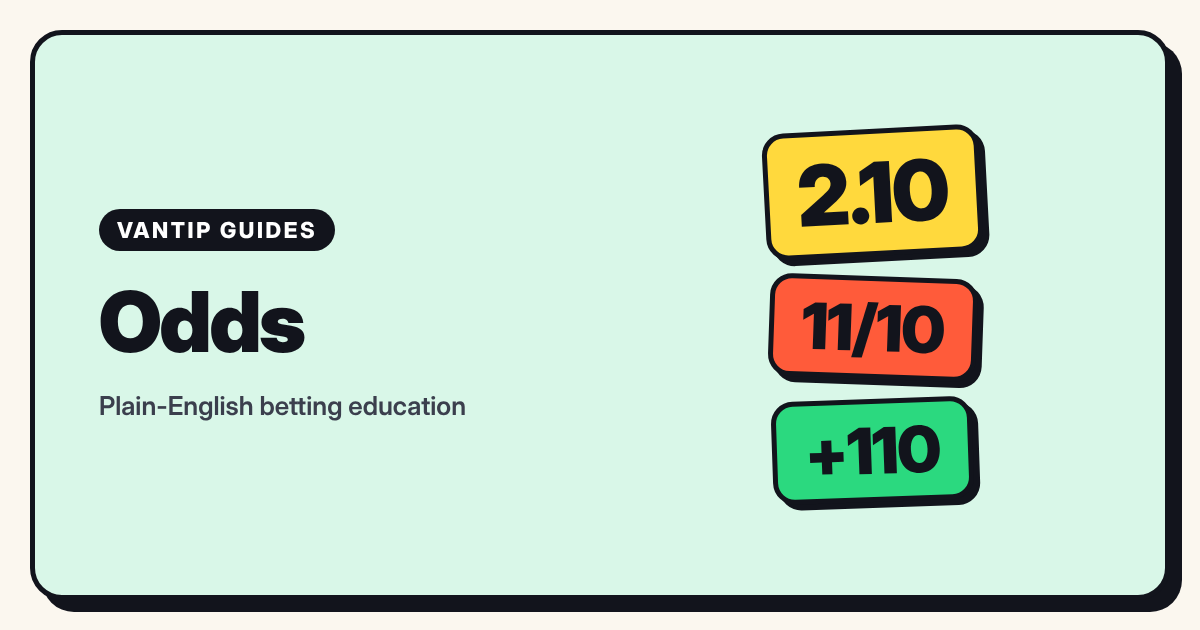
- Home win: decimal 2.10, fractional 11/10, American +110
- Draw: decimal 3.40, fractional 12/5, American +240
- Away win: decimal 3.60, fractional 13/5, American +260
Check one by hand. Fractional 12/5 is 2.4, plus 1 gives 3.40. American +240 is 240 / 100 = 2.4, plus 1 gives 3.40. All three describe the same price.
A cheat sheet for decimal odds and probability
You will use these conversions constantly, so it helps to know the common ones:
- 1.25 implies 80%
- 1.50 implies 66.7%
- 1.80 implies 55.6%
- 2.00 (evens, 1/1 or +100) implies 50%
- 3.00 implies 33.3%
- 4.00 implies 25%
- 6.00 implies 16.7%
- 10.00 implies 10%
Two special cases are worth remembering. Evens is decimal 2.00, fractional 1/1 and American +100. The most common American spread price, -110, is decimal 1.91, and it implies 52.4%.
What odds tell you about favourites and underdogs
The shorter the price, the more likely the bookmaker thinks the outcome is. In decimal odds, anything under 2.00 is a favourite, and anything over 2.00 is an underdog. In American odds the favourite carries the minus sign, and in fractional odds the favourite has the larger number on the right, such as 1/2.
Longer odds do not mean better value. A 10.00 outsider pays well when it wins, but it wins only about one time in ten if the price is fair. Whether the price is good depends on whether that estimate is right, and that is the subject of value betting explained.
Why different bookmakers show different odds
Each bookmaker sets its own prices, based on its own model, its own margin and the bets it has taken. The same outcome can be 2.05 at one bookmaker and 2.20 at another. Over time that difference is large: the gap between a break-even probability of 48.8% at 2.05 and 45.5% at 2.20 is more than three points. Comparing prices before you bet is the simplest way to improve your results without changing a single pick.
A short routine before any bet
- Convert the price to a probability, using 1 divided by the decimal odds.
- Ask whether that probability is lower or higher than your honest estimate.
- Compare the price with at least one other bookmaker.
- Check the market and how it settles. See betting markets explained.
- Decide the stake from your budget, not from the odds. See bankroll basics.
Frequently asked questions
Are higher odds better? No. Higher odds mean a less likely outcome and a bigger payout. Neither is better, only more or less fairly priced.
What does it mean when odds drift or shorten? A shortening price (for example 2.10 to 1.95) means the market has become more confident in that outcome. A drifting price means less confident. See closing line value.
Do the odds include my stake? In decimal odds, yes: the number is your total return. In fractional and American odds, the number describes profit, and your stake comes back on top.
Which format does Vantip use? Decimal by default, which our odds converter can change into the other two.
Vantip Team. Information only, not betting advice. 18+. Betting carries risk; see our Responsible Gambling page.
Written by the Vantip Editorial Team. See how we analyse matches and build our predictions.
For informational purposes only. Betting involves financial risk — never stake more than you can afford to lose. 18+ · Gamble responsibly.