Implied Probability and the Bookmaker's Margin, Explained
How to turn odds into probabilities, see the margin built into every market, and remove it with a worked three-way football example.
Every set of odds contains two things: a probability estimate and the bookmaker's fee. Separating them is the most useful piece of maths in betting, and it only needs a calculator. This guide shows how, with a worked example.
Step 1: Convert odds to implied probability
With decimal odds, implied probability is 1 divided by the odds. Take a football match with these prices:
- Home win: 2.10
- Draw: 3.40
- Away win: 3.60
The implied probabilities are:
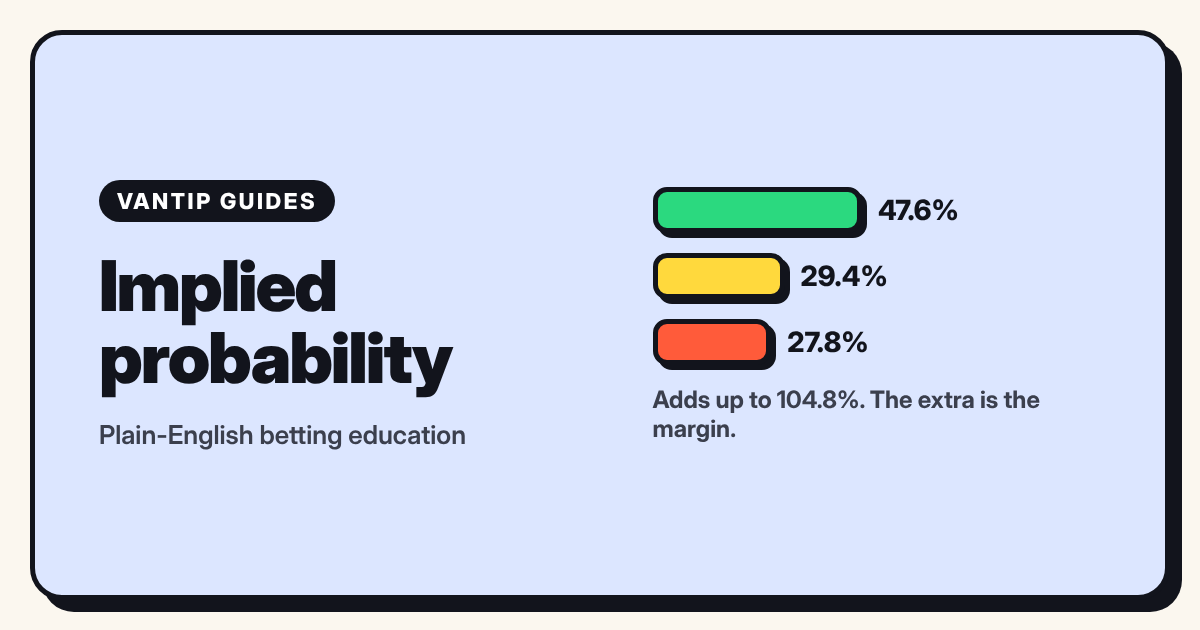
- Home: 1 / 2.10 = 47.6%
- Draw: 1 / 3.40 = 29.4%
- Away: 1 / 3.60 = 27.8%
Step 2: Add them up
47.6 + 29.4 + 27.8 = 104.8%.
A fair market would add up to exactly 100%, because one of the three outcomes must happen. The extra 4.8 points is the bookmaker's margin, also called the overround or vig. It is built into the prices so the bookmaker profits over time whichever outcome occurs.
Step 3: Remove the margin
The simplest method is proportional: divide each implied probability by the total.
- Home: 47.6 / 104.8 = 45.4%
- Draw: 29.4 / 104.8 = 28.1%
- Away: 27.8 / 104.8 = 26.5%
These add up to 100%. They are the market's no-margin view of the match, and the best neutral starting point for judging any pick. Proportional removal is an approximation, because some analysts take more margin off longshots than favourites, but for everyday use it is accurate enough.
A two-way example
Over 2.5 goals at 1.90 and under 2.5 goals at 1.95:
- Over: 1 / 1.90 = 52.6%
- Under: 1 / 1.95 = 51.3%
- Total: 103.9%, so the margin is 3.9%
- Without the margin: over 50.6%, under 49.4%
Why this matters
- It shows the real cost of betting. With a 4.8% margin, backing every outcome in proportion to its true chance would return only about 95.4% of your stakes. Beating the market means overcoming that fee first.
- It lets you compare bookmakers. A lower margin means better prices. Two-way markets such as over/under and Asian handicap often carry lower margins than three-way markets.
- It is how we anchor our own numbers. Vantip's AI confidence starts from the market's no-margin probability, which is why it usually sits close to the odds. See how our tips work.
Quick checklist
- Convert every price to 1 divided by the odds.
- Add the results to find the margin.
- Divide each by the total to get no-margin probabilities.
- Compare your own estimate with the no-margin figure, not the raw implied one.
Use the odds converter to check your conversions, and read value betting explained for what to do with the result.
A second worked example: a tennis match
Two-way markets are simpler, so let us use one. A tennis match is priced at 1.45 for Player A and 2.80 for Player B.
- Player A: 1 / 1.45 = 69.0%
- Player B: 1 / 2.80 = 35.7%
- Total: 104.7%, so the margin is 4.7%
- Without the margin: Player A 65.9%, Player B 34.1%
Notice what changed. The raw 69.0% overstates Player A's chance by more than three points. If you judged a bet using the raw figure, you would believe the favourite was more likely than the market really thinks.
The same market at two bookmakers
Margins differ between bookmakers. Take the football match from earlier, priced at 2.10, 3.40 and 3.60 by one bookmaker. A second bookmaker offers 2.15, 3.40 and 3.70:
- Home: 1 / 2.15 = 46.5%
- Draw: 1 / 3.40 = 29.4%
- Away: 1 / 3.70 = 27.0%
- Total: 102.9%, a margin of 2.9%
The second price carries a margin of 2.9% against 4.8% at the first bookmaker. Over many bets, that gap is worth far more than most people realise. It is also the reason to compare prices, and to pick the best price for each outcome.
A note on longshots
Removing the margin proportionally assumes that it is spread evenly across the outcomes. Research on betting markets has often found that longshots tend to be priced a little worse than favourites, which means the true chance of a longshot can be slightly lower than the proportional figure shows. For everyday use the proportional method is a sensible starting point, as long as you keep in mind that it is an approximation.
Three ways to use no-margin probabilities
- As a baseline for your own estimates. Start from the no-margin figure and adjust only for things you can name, such as a confirmed injury. This is how our AI works. See how our tips work.
- To compare bookmakers. The lower the total of the implied probabilities, the lower the margin.
- To judge value. A price only has value if your probability is higher than the break-even figure, which is 1 divided by the odds, margin included. See value betting explained.
Try it yourself
A match is priced at 1.80 for the home side and 2.00 for the away side, with no draw. Work out the margin and the no-margin probabilities.
- Home: 1 / 1.80 = 55.6%
- Away: 1 / 2.00 = 50.0%
- Total: 105.6%, so the margin is 5.6%
- Without the margin: home 52.6%, away 47.4%
Common mistakes
- Using the raw implied probability as if it were the true chance.
- Forgetting that the margin differs between bookmakers and between markets.
- Comparing the probabilities of different markets without adjusting for the margin in each.
- Believing that a price with a small margin is automatically good value. A low margin is better, but value still depends on the probability.
Vantip Team. Information only, not betting advice. 18+. Betting carries risk; see our Responsible Gambling page.
Written by the Vantip Editorial Team. See how we analyse matches and build our predictions.
For informational purposes only. Betting involves financial risk — never stake more than you can afford to lose. 18+ · Gamble responsibly.