Closing Line Value: What It Is and Why Serious Bettors Track It
Closing line value compares the price you took with the final price before kick-off. Learn how to calculate it and why it matters.
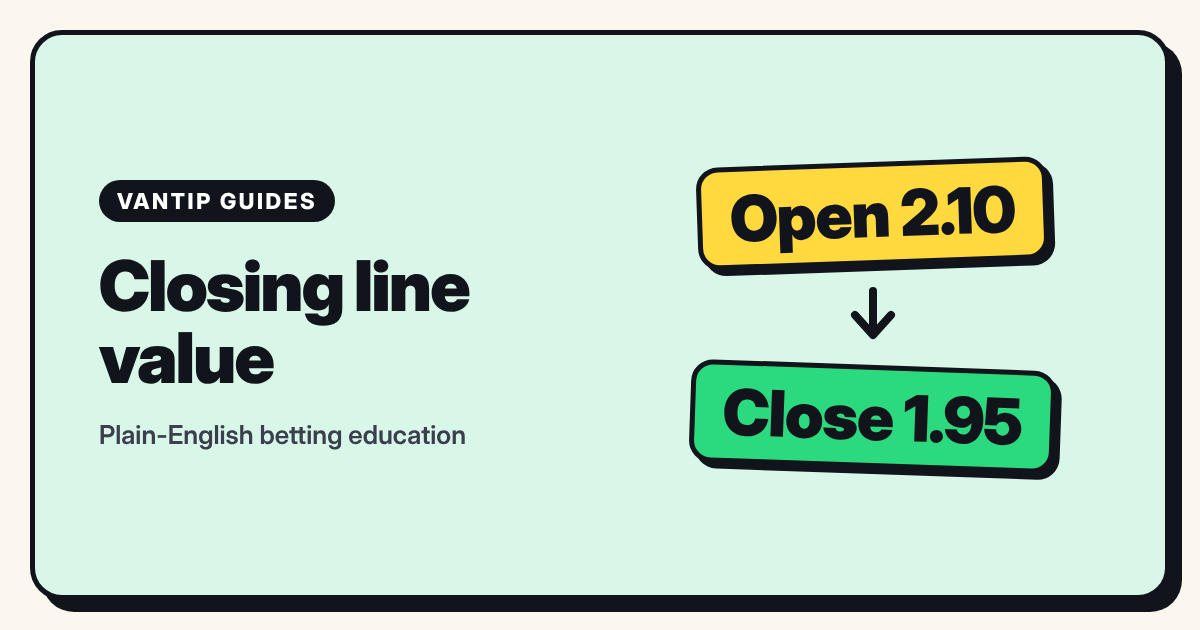
Closing line value, or CLV, answers a simple question: did you get a better price than the market's final price? It is the favourite measure of serious bettors because it gives you a signal far faster than results do.
What the closing line is
Odds move between the moment a market opens and kick-off, as money arrives, teams are announced and injuries are confirmed. The price at kick-off is called the closing line. Because it contains the most information, it is widely seen as the most accurate estimate of a match's true probabilities.
How to calculate CLV
Compare the odds you took with the closing odds, as implied probabilities.
- You back a team at 2.10, which implies 1 / 2.10 = 47.6%.
- The price closes at 1.95, which implies 1 / 1.95 = 51.3%.
The market moved towards your side and agreed with you more than the price you took. Your price was better than the close, so you have positive CLV. In this example the gap is about 3.7 percentage points.
If the price had drifted from 2.10 to 2.30 you would have negative CLV: the market moved against you and you took a worse price than the final one.
Why CLV matters more than short-term results
Results are noisy. As we explain in variance and sample size, even a genuine edge can take hundreds of bets to show in profit. CLV does not depend on whether the team won. It measures whether your price beat the final market, and that shows up much sooner.
The logic is simple. If the closing line is a good estimate of the truth, then consistently beating it means you are consistently getting better prices than the truth justifies, and that is positive expected value in practice. See expected value in plain English.
What CLV does not tell you
- It is not a guarantee of profit. Positive CLV with a high margin can still lose money.
- It needs a good closing line. In thin markets, such as lower leagues, the close is less reliable.
- It depends on timing. Taking a price early, before it moves, is the main way CLV is earned, and tipsters who publish after the price has moved do not capture it.
- It can be gamed. A bettor who only backs the favourites that always shorten will show good CLV in a small sample for the wrong reasons.
How to track it yourself
- Record the odds, the bookmaker and the time of every bet.
- Record the closing odds from the same or a sharp source.
- Convert both to implied probability and subtract.
- Look at the average over at least a few hundred bets.
Using CLV to judge a tipster
When you evaluate any tipster or tips site, ask:
- Were the odds shown available at the time the tip was published, or only later?
- Is each tip logged before kick-off, and are results edited afterwards?
- Are the odds the ones you could actually get?
On Vantip every tip is logged before kick-off, and every result is public on the Track Record page, with no retroactive edits. Our methodology describes how a tip is made and settled.
Takeaways
- CLV compares your price with the final price.
- Positive CLV is the best early sign of a real edge, and negative CLV is an early warning.
- It needs a large sample and a reliable closing line.
- It is a skill indicator, not a profit guarantee.
Vantip Team. Information only, not betting advice. 18+. Betting carries risk; see our Responsible Gambling page.
Written by the Vantip Editorial Team. See how we analyse matches and build our predictions.
For informational purposes only. Betting involves financial risk — never stake more than you can afford to lose. 18+ · Gamble responsibly.